Wednesday, June 8, 2016

Women's Views on News

Women's Views on News


Peace Signs: preventative photography

Posted: 07 Jun 2016 07:42 AM PDT

Edward Barber, photographer, IWM, Peace Signs, Greenham Common, Exhibition‘The photographs here are both a celebration and a warning.'

The London Imperial War Museum (IWM London) is currently holding an exhibition of work by photographer Edward Barber, 'Peace Signs', showing more than 40 photographs that explore the anti-nuclear protest movement in 1980s Britain.

Among them are the iconic 'Embrace the Base' showing some of the 30,000 women linking hands, completely surrounding the nine-mile perimeter fence at RAF/USAF Greenham Common, Berkshire, taken in 1982; the Labour Party's 'Nuclear Arms No – Peace Yes' rally in Hyde Park, London in 1980, and the 'Stop the City' protester at the Bank of England, City of London, in 1983, with the sign reading 'War Stocks Move Up'.

The exhibition is a contemporary reinterpretation of photographs taken by British documentary photographer Edward Barber, who recorded major protests staged at key sites such as RAF/USAF Greenham Common, Westminster, Trafalgar Square and the City of London.

Peace Signs, Barber's collected body of work, was originally taken to attract media attention to the anti-nuclear movement, and this exhibition will explore these protests as multi-generational and distinctly British forms of self-expression.

The photographs are a unique social document of mass popular protest in late twentieth century Britain and have rarely been seen in public since they was first published in 1984.

Barber's images create a social record of both individual and collective responses to war, as well as illuminating the activists' humour and creativity.

The photographs capture hand-rendered signs, banners, badges, clothing, make-up and costumes, and illustrate the often overlooked role of performance theatre, folk art and fashion at peace camps and demonstrations.

They also highlight the important role of women in the movement and the activity of the female-only protest camp at RAF/USAF Greenham Common, which marks its 35th anniversary this year.

Selections of Barber's photographs were first published in international media outlets like The Guardian, The Observer Magazine, NME and US News & World Report in the 1980s.

They were also disseminated globally by the Campaign for Nuclear Disarmament (CND) and published as part of the book ‘Peace Moves: Nuclear Protest in the 1980s’ by Zoe Fairburns and James Cameron  in 1984.

The photographs also toured nationally in 1984 as the exhibition Bomb Disposal, to venues such as Camerawork, London and Watershed, Bristol. His images were also shown at the ICA and Tate Britain.

The display offers a fresh interpretation of the images: the photographs will be contextualised by a graphic installation entitled ‘Mind Map of Anti-Nuclear Protest’, created by Barber specifically for this exhibition.

The Mind Map will trace his contemporary re-evaluation of the events he captured in the 1980s.

As a British documentary photographer Barber is best known for his portrait work which, during a career spanning 40 years, has been exhibited widely in the UK by The Design Museum, Museum of London, National Portrait Gallery, The Photographer's Gallery and the V&A.

He is also a designer, curator and teacher, and used to be the Subject Director for Fashion Photography at the London College of Fashion.

‘Peace Signs’ will be on show at IWM London until 4 September 2016. Admission is free.

Don’t forget: it’s your referendum

Posted: 07 Jun 2016 07:35 AM PDT

#yourreferendum, Momentum, Another Europe is Possible, new initiative, ReferendumNew platform to take back the EU referendum from the Tories, UKIP and ‘Project Fear’.

On 23 June, Britain will take the massive decision to remain in or leave the European Union.

Sadly, many feel that much of that debate so far has been an alienating squabble between different factions of the Tory Party.

But this isn’t their referendum, it’s your referendum.

So Momentum and Another Europe is Possible have created #YourReferendum, a crowdsourced, online platform for campaigning and organising tools to take the debate out of Westminster and into our communities.

A platform to take back this referendum from the Tories, UKIP and ‘Project Fear‘ and make it yours.

A way to take the stuffy EU Referendum debate out of Westminster and into our communities.

The #YourReferendum webpage will develop alongside the activism that takes place across the country.

It has a space for your ideas: for example what do you think referendum campaigners should be doing?

You can add your ideas to the site, and upvote the ones you like.

You can download your EU campaign materials so that other people can use them: send any templates or resources you’re using in your campaigning to yourreferendum@peoplesmomentum.com, so they can be shared with thousands of other citizen campaigners all over the UK.

You can see where there is a Labour In event near you, and you can find other events near you – or add yours.

You can also download a Doorstep EU app: 'an invaluable pocket guide to the European Union [EU] and Britain’s place in it. Designed for anyone who’s interested in the relationship between the UK and the EU.'

This is an astonishingly useful tool for EU doorstep campaigners when faced with “I’ve read that …”.

It rates each press story for reliability and accuracy based on evidence, showing how biased much of the press is in favour of Brexit and how willing they are to twist or even invent Eurosceptic evidence.

And there are also tables of statistics on jobs and investment, a myth buster section and some clear explanations of various aspects of the EU.

Momentum was set up to build on the energy and enthusiasm that arose during the 'Jeremy Corbyn for Labour Leader' campaign, and aims to increase participatory democracy, solidarity, and grassroots power and help Labour become the transformative governing party of the 21st century.

'Another Europe Is Possible' is a campaign for a radical 'in' vote in Britain’s EU referendum.

It campaigns to put the case for staying in the EU independently of Cameron and big business, opposing any part of a "renegotiation" that attacks workers', migrants' or human rights.

And it combines campaigning for an in vote with arguing for an alternative economic model, maintaining European citizens' rights to live and work across the EU, and for far-reaching democratic reforms of European institutions.

A British exit from the EU, Another Europe says, would have a seriously detrimental impact on the free movement of people; trade union and human rights; environmental protection; international cooperation; and a host of other vital issues.

While, at the very least, the EU is in desperate need of a democratic overhaul, an exit at the current time would boost rightwing movements and parties and hurt ordinary people in the UK. European politics has been dominated by neoliberal thinking for far too long – as recent events in Greece brutally demonstrate.

But changing this means working to strengthen anti-austerity movements across all of Europe – not walking away. #DontWalkAway

For more #YourReferendum info, click here.

Tuesday, June 7, 2016

Women's Views on News

Women's Views on News


Domestic abuse: insufficient police response

Posted: 06 Jun 2016 06:08 AM PDT

police federation conference, Theresa May, domestic abuse, violence, The Home Secretary has once again had to acknowledge the police are failing domestic abuse victims.

Speaking at the Police Federation's annual conference recently, the Home Secretary, Theresa May, said  that "victims of abuse are still being let down and reports are not being taken seriously enough".

In 2013, May commissioned a review of the police response to domestic abuse, and the results were damning.

And when a report by Her Majesty's Inspectorate of Constabulary (HMIC) called 'Everyone's business: Improving the police response to domestic abuse', was released the following year, the Home Secretary herself said that it made "depressing reading".

HMIC inspects policing in the public interest.

The author of the report, Zoe Billingham, said at the time: "The service provided to victims of domestic abuse by the police is too often unacceptable.

"Police leaders told us tackling domestic abuse is important, but in the majority of forces it is a priority on paper only and not in practice.

"It is deeply disappointing that the stated intent is not translating into an operational reality.

"The police service urgently needs to improve its overall response."

At this year's Police Federation conference, May said that while improvements have been made since the 2013 review, "examples of the same shameful behaviour persisted."

‘This shameful behaviour’ includes victims being referred to as 'bitch' and 'slag' by police officers, and comments from responding officers responding to calls saying for example, 'it's a DV, we'll be a few minutes and we'll go to the next job'.

She also spoke out against the officers "who put victims of serious domestic violence into a room with their attacker in the name of restorative justice, with no consideration of the psychological and emotional damage that can cause.

"I know that restorative justice is meant to be victim-led and I know that guidance says it should be considered in all cases," she said, "but I simply do not believe it follows either the evidence or common sense to sit vulnerable victims across from perpetrators who for months and years may have destroyed their confidence, manipulated their mind, and beaten their bodies."

May also told the conference, "the right skills, training and commitment to protect the vulnerable are still not held by every single police officer", and spoke of "officers who couldn't spot dangerous patterns of abuse."

As a result of the 2013 review, every police force in England and Wales now has an action plan to tackle domestic abuse and they are collecting standardised data.

However, as May said at the conference, "not a single one of these police forces is outstanding at protecting those who are vulnerable from harm and supporting victims, and 31 forces are judged to be either inadequate or requiring improvement."

The Home Secretary also highlighted an extremely worrying issue with regard to the way in which police officers treat domestic abuse cases and victims.

"We know of officers who develop inappropriate relationships with victims of domestic abuse.

"They have ignored their professional duty and their moral responsibility and instead abused their position of power to exploit victims.

"We do not know the true scale of this, but everyone in this room will know it goes on far more than we might care to admit".

In response to this, May has asked HMIC, headed by Sir Tom Winsor, to investigate this issue.

It is certainly a relief, and a moment of significance, to see the inadequacy of the way in which domestic abuse is dealt with properly recognised by a government minister.

We have to ask however, is this down to the fact that the Home Secretary is a woman? Would it be taken as seriously if the Home Secretary were a man?

And does David Cameron, or the other male members of Parliament, regard domestic abuse as the urgent matter that it is?

Unfortunately, the government’s response to domestic abuse and the way it is handled has tended to be all talk and no action.

With an average of two women a week killed by a partner, spouse or ex we cannot afford to take a lax attitude – and the government and the police need to cooperate to take effective action immediately.

The increase in the number of victims actually reporting perpetrators to the police is of course a positive step, however it is meaningless if these reports are not dealt with properly.

Particularly as many of those reporting abuse are potentially risking their lives by coming forward.

Thus far the attitudes towards domestic abuse and its victims within the police, which can only be described as utterly disgraceful, are, sadly, reflections of those in wider society, and there are many organisations and services, not just the police, that need to make changes so that victims get proper help, protection, and justice, and perpetrators appropriate punishments.

Hopefully, the Home Secretary will now lead the way in making sure these changes are made. And soon.

Report says Britons dying needlessly

Posted: 11 May 2016 01:20 PM PDT

Better regulation, better for whom, Professor Steve TombsLives lost and shortened and the health of communities, workers and consumers made poorer.

Thousands of British citizens are dying needlessly each year because of the government's failure to tackle food poisoning, health and safety breaches and pollution, according to a new report from the Centre for Crime and Justice Studies.

The report – Better Regulation: Better for whom? – by Professor Steve Tombs, of The Open University, argues that lax regulation and weak enforcement have created avoidable business-generated, state-facilitated 'social murder'.

Each year, the report says, some 29,000 deaths are attributable to airborne pollution.

A further 50,000 people die as a result of injuries or health problems originating in the workplace – and most of those deaths are caused by diseases that may cause many years of illness before their victims die.

There are around one million cases of foodborne illness in the UK each year, and food poisoning leads to some 20,000 people being hospitalised and 500 deaths each year.

And, says the report, in each of these areas, the majority of these deaths originate in profit-making businesses.

This is not just a problem of infrequent inspections and lax enforcement.

In the name of cutting red tape, governments of all political persuasions have, for over a decade, undermined independent and effective business regulation.

And budget cuts under the austerity programme have compounded the problem.

So too have moves to outsource and privatise regulatory and enforcement activity.

And these staggering figures, Professor Tombs said, are probably underestimates.

They are also largely avoidable.

Successive governments have undermined the independent inspection of business over many years, the Better Regulation report points out.

An average business can now expect a local authority health and safety inspection only once in every 20 years.

Between 2004 and 2013, there were 34 per cent fewer food standards inspections and 28 per cent fewer prosecutions; 53 per cent fewer health and safety inspections and 40 per cent fewer prosecutions; and 56 per cent fewer environmental health inspections and 40 per cent fewer prosecutions.

More recent figures, not included in the briefing, show that between 2004 and 2015, at Local Authority level, there were 35 per cent fewer food standards inspections and 35 per cent fewer prosecutions; 69 per cent fewer health and safety inspections and 60 per cent fewer prosecutions; and 55 per cent fewer environmental health inspections and 30 per cent fewer prosecutions.

Recent years have also seen the privatisation of regulatory and enforcement activities, and a shift to business self-regulation.

Regulation is widely derided, a dirty word now equated with red tape, rules, burdens and bureaucracy.

Yet we would do well to recall that regulation of business emerged ostensibly to provide some levels of 'social protection' for workers, consumers and communities from the worst excesses of the industrial revolution.

The emergence of neo-liberalism provided the context for a concerted attack on regulation in the name of freeing business from the burdens of red tape.

But as the diesel emissions scam currently engulfing Volkswagen and other motor manufacturers, or the recent scandal over horsemeat in food, tell us businesses cannot simply be trusted to act in the public interest without robust, independent, state-backed regulation.

And as the report documents, the cumulative trends away from regulation and enforcement may 'mark the beginning of the end of the state's commitment to, and ability to deliver, social protection'.

Will McMahon, deputy director of the Centre for Crime and Justice Studies, said: 'The public is led to believe the greatest harms faced by citizens are dealt with by the police and courts.

'Professor Tombs' Briefing makes clear that this is far from the case.

'The harms he writes about are not random happenings but the result of political and economic decisions,’ McMahon continued.

'Policy makers need to urgently address the radical reduction in local authority inspections and enforcement'.

'This is not about rules, regulations and red tape,’ Professor Steve Tombs said. ‘It is about lives lost and shortened and the health of communities, workers and consumers made poorer.

'This is avoidable business-generated, state facilitated social murder.

‘And quite remarkably, it proceeds daily, met largely by political silence.'

Saturday, June 4, 2016

Women's Views on News

Women's Views on News


Cheryl James inquest verdict given

Posted: 03 Jun 2016 02:20 PM PDT

Cheryl James, Deepcut, 2016 inquest verdict, LibertyLiberty now calls for reform to tackle pervasive sexualised culture in the Armed Forces.

The Coroner in the inquest into the 1995 death of Private Cheryl James at Deepcut Barracks has today recorded a verdict of suicide, and delivered a narrative verdict that severely criticised serious failures in the Army's duty of care at Deepcut barracks.

His Honour Judge Brian Barker QC delivered his conclusions at Woking Coroner's Court after a three-month inquest which heard evidence from more than 100 witnesses.

Cheryl James was 18 and undergoing initial training when she was found dead with a bullet wound on 27 November 1995. Surrey Police immediately allowed the Army to take over the investigation into her death. No ballistics or forensics tests were conducted.

The original inquest, held three weeks after her death, lasted just an hour. Key witnesses were not called, medical records uninspected and important evidence ignored.

In 2011, Cheryl's parents Des and Doreen James approached Liberty, who threatened Surrey Police with legal action under the Human Rights Act unless they provided access to the materials held concerning Cheryl's death.

Over the next two years, Surrey Police released more than 90 lever-arch files of statements, documents, forensic evidence and photographs, allowing the family to apply for a fresh inquest.

HHJ Barker ruled that Article 2 of the European Convention on Human Rights was engaged and this enabled him to deliver the critical narrative verdict.

Des James' full response to today's verdict can be read here.

Liberty represents the families of three of the four young recruits who died at Deepcut between 1995 and 2002 – including Privates Sean Benton and James Collinson – and will continue to seek the fresh inquests they and their families deserve.

Following today's verdict, Liberty is now calling for a meaningful reform of the military justice system to tackle the ongoing, pervasive and deeply damaging culture of sexualised behaviour and harassment in the Armed Forces.

Brigadier John Donnelly, questioned at the inquest, said: "…in 2014, we conducted a survey about 24,000 members of the army, all the female servicewomen and some servicemen too, to have a better understanding of the problem of sexual harassment in the army, to really understand the problems so we could make the cultural change.

"And the results were quite clear, that 90 per cent of respondents felt that the army had an overly sexualised culture, or certainly sexualised culture.

"39 per cent of respondents had had a distressing experience, sexual harassment or conduct short of harassment about 12 per cent had actually made a complaint and taken it further and found the whole thing very distressing, but also that a significant number of respondents did not have confidence in the complaint process."

In 2014, Opportunity Now also conducted research which demonstrated that 23 per cent of women in the uniformed and armed services suffer sexual harassment. The average elsewhere is 12 per cent.

Section 113 of the Armed Forces Act 2006 requires a Commanding Officer, when s/he becomes aware that certain criminal offences may have been committed, to refer the matter to the service police for investigation. The list of offences that must be referred to police are contained within Schedule 2 to the Act. A small group of offences are excluded from this mandatory referrals process, one of which is sexual assault.

Emma Norton, lawyer for Liberty and solicitor for Mr and Mrs James, said: "This day has come 20 years too late. There should have been an independent police investigation right from the start.

"The Army should have been open about life on that camp from day one. Cheryl's family and friends would have been saved 20 years of unnecessary suffering and pain – and things might have changed for the better, serving the interests of the bereaved, serving soldiers and the British Army.

"It is not good enough for the Army and Ministry of Defence (MoD) to wait two decades, point to the things that have changed and pat themselves on the back for saying sorry.

"Sexual harassment continues to afflict our armed forces more than any other sector – and failings in our military justice system mean those who report an assault are still not guaranteed the fair, independent investigation and support they deserve.

"If there was ever a day for the MoD to commit to change and show they actually care about ending this toxic culture, today is that day."

In 2016, it is still lawful for:

A Commanding Officer in the Armed Forces to choose to investigate an allegation of sexual assault him or herself. There is no legal requirement – as there is for most other criminal offences – to refer the matter to the police; and

Military police to investigate serious criminal offences including rape, sexual assault and other violent crime.

Liberty is campaigning for the government to amend the law to end these practices and embed independence and fairness for the country's troops at the heart of the military justice system.

The inquest exposed to public scrutiny the deeply toxic environment in which Cheryl James and hundreds of other young soldiers lived.

It revealed:

Unworkable supervision ratios of as few as one supervisor to 200 trainee soldiers;

Unsupervised access to alcohol, including for under 18s;

No formal welfare policy and essentially no welfare support for young people, many of whom were vulnerable and away from home for the first time; and

A highly sexualised environment with some male supervisors seeing young female trainees as a sexual challenge – and nowhere for a young soldier seeking advice and support to go.

These failures were only admitted by the MoD for the first time during the inquest, more than 20 years after Cheryl James died.

Emma Norton said: "The evidence revealed a brutal and morally chaotic environment, particularly for young women, which amounted to a deeply harmful failure in the duty of care they were owed."

The inquest revealed that Surrey Police conducted no investigation whatsoever in 1995, leaving the military police to investigate a sudden death on military property themselves. This amounted not to an investigation into a potential crime, but to a preparation of a series of statements for the then Coroner based on an assumption of suicide.

Given the lack of any basic policing and forensic work at the scene, Surrey Police's agreement to investigate in 2002 came too late.

Investigating officers' behaviour was deeply inappropriate at times and internal memorandums have revealed that – before the bulk of witnesses were interviewed and expert evidence obtained – senior officers believed they had enough information to be satisfied as to how Cheryl James and the three other recruits had died, and needed only to focus on why they had died.

Liberty now urges anyone who has suffered sexual or other abuse while at Deepcut or while serving in the armed forces to report their experiences to police.

A dedicated Surrey Police officer has been identified to deal with any allegations of assault at Deepcut.

Anyone with concerns about contacting Surrey Police can of course contact Liberty in confidence.

End sexist dress codes at work

Posted: 03 Jun 2016 01:41 PM PDT

shoes at work, sexism, high heels, footwear‘If you can give me a reason as to why wearing flats would impair me to do my job, then fair enough’.

Another form of sexism and discrimination against women in the workplace has hit the headlines.

In the same week, two incidents highlighting the issue of sexist dress codes at work caused outrage across the internet and on social media.

It began when receptionist Nicola Thorp, 27, claimed that she had been sent home from her first day of agency work at corporate company PricewaterhouseCoopers (PwC) for not wearing 2-4 inch heels.

She told BBC Radio London: “I said, ‘if you can give me a reason as to why wearing flats would impair me to do my job today, then fair enough’, but they couldn’t.

“I was expected to do a nine-hour shift on my feet escorting clients to meeting rooms. I said I just won’t be able to do that in heels.”

She added, “apart from the debilitating factor, it’s the sexism issue … companies shouldn’t be forcing that on their female employees.”

Thorp said that she was laughed at when she pointed out that this policy was discriminatory and was sent home without pay after refusing to go and buy a pair of high heels.

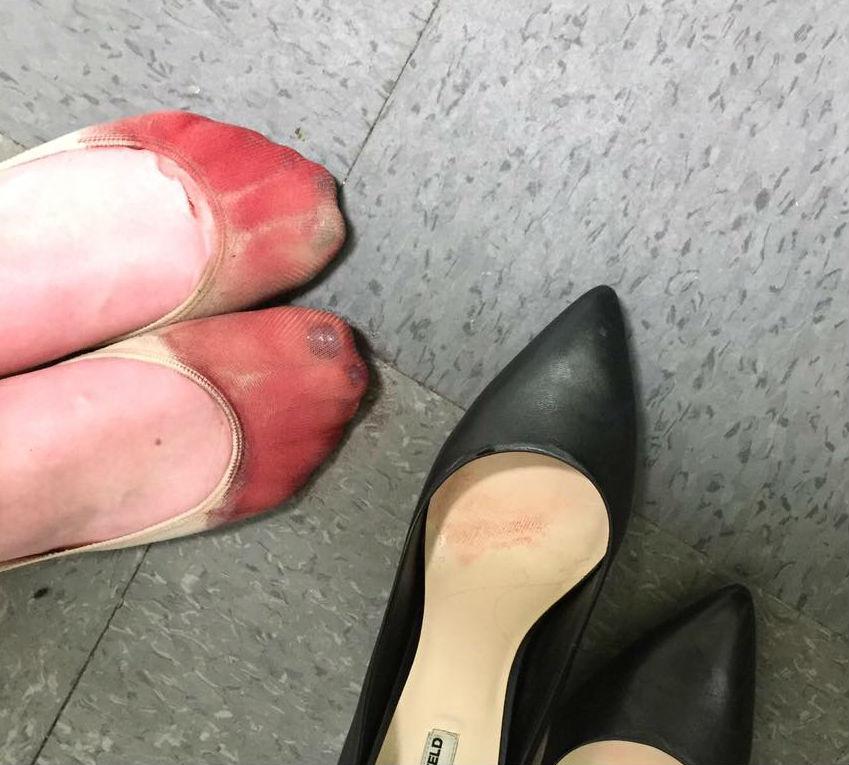
At the same time, a photo of an American waitress’s bloody feet after having to do a shift in heels went viral.

Nicola Gavin took the photograph of her friend’s feet and said that she actually lost a toenail as a result of having to serve customers while wearing high heels.

Gavin also claimed that female employees of Joey Restaurants, the chain her friend works for, are required to spend USD30 to buy a black dress uniform while male employees can choose their own black clothing.

Unfortunately, these two incidents are not one-offs, as we discovered when we asked women if they had any similar experiences.

One woman who worked for an agency that puts employees in Harrods and in Oxford Street department stores told us that along with a pencil skirt, female employees had to wear heels of a certain height and have their nails painted to match the colour of their lipstick.

“I’d work for eight hours but within 15 minutes I’d be in pain, and I would spend my lunch breaks crying and rubbing my feet,” one woman said.

Another woman said that at a pub she worked in, people who gave in their CVs were rated out of 10 based on their appearance, and if they were regarded as anything under a 7, their CV would be put in the bin.

And in addition, during the World Cup female bar staff had to wear little shorts with knee high socks and were encouraged to wear heels during busy periods to ‘look sexy’ in order to attract customers.

A former employee of Specsavers also told us that she had to get a doctor's note for her back problems so she could be excused from wearing heels.

“If I’d worn flat shoes, I would have gotten disciplinary warnings and eventually been sacked for not abiding to the dress code requirements – despite the fact that I was on my feet for eight hours a day,” she said.

These demands for ‘heels’ stem from the longstanding sexual objectification of women, who are regarded as submissive tools for attracting customers and clients instead of valuable employees equal to their male colleagues.

And the experiences of all of the women who have come forward since the stories broke suggest that the ‘sexy secretary’ and ‘sexy barmaid’ stereotypes are more prominent than we might like to think, even now.

It seems that in many cases, a woman’s value in the workplace is still based on her physical appearance and not her intelligence or skills she may possess.

And it is shocking that these practices are still rife in 2016, and that it is still legal for an employer to make women wear high heels at work.

Not only are these dress codes grossly unfair, given that they don’t apply to men, but they can also have negative health implications for women.

The damaging effects of wearing heels on a regular basis, particularly for the feet and back, are well-known, and the pain of doing so is too much for many women to bear – myself included.

The TUC, with admirable courteous understatement, has said in its health and safety guidance Working Feet and Footwear:  'In many occupations, in particular where staff deal with the public, employers enforce a dress code that includes footwear.

'Sometimes this code prevents staff from wearing comfortable and sensible shoes and instead insists they wear slip-ons or inappropriate heels.

'This can apply particularly to women.

'Apart from being extremely sexist, these policies can lead to long-term foot problems. Safety representatives should ensure that dress codes do not prevent people from wearing comfortable, healthy footwear.'

Women can still look perfectly smart and professional at work without wearing high heels, skirts or make up – it is not as if the only other alternative is tracksuit bottoms.

There is absolutely no reason why dress codes shouldn’t be the same for men and women, and perhaps this would afford women a little more respect in the workplace (we can but hope…).

Women already face a lot of challenges at work, particularly in male-dominated industries, and the last thing they need, and deserve, is to have to tackle these challenges while enduring the pain and discomfort of wearing high heels.

According to ibtimes, the agency in Nicola Thorpe’s sorry story, Portico, has since changed its uniform guidelines, and PwC’s spokeswoman has since then said: “We are now reviewing our supplier uniform codes to ensure they are aligned with our own values.”

So if we could only get the issue raised more widely…

You can sign Nicola Thorp’s petition to make it illegal for a company to require women to wear high heels at work here. Please do.

Friday, June 3, 2016

Women's Views on News

Women's Views on News


Looking at local government

Posted: 02 Jun 2016 02:52 PM PDT

fawcett society, women in local government, Northern Powerhouse, Plans for a Northern Powerhouse continue, but gender equality continues to lag behind.

This year the Fawcett Society will be assessing whether local government is working for women, and along with the Local Government Information Unit (LGIU) has launched a year-long Commission, jointly chaired by Labour's Dame Margaret Hodge MP and Conservative councillor Gillian Keegan, director of Women2Win.

Funded by the Barrow Cadbury Trust, the Commission will focus on the newly created structures at local level and how they are including or excluding women.

The Commission will be gathering evidence throughout the year and holding meetings around the country and will produce a final report – with recommendations – to ensure women are better represented at every level of local government and that the opportunities for greater gender equality presented by devolution are not missed.

It will see evidence-gathering on:

Women's representation at a local level, and in particular focus on women in positions of power and leadership and where women make a positive difference;

The barriers to women's participation and representation and the practical solutions which would enable more women to participate; and

The diversity of women's representation including BAME women, disabled women, those with caring responsibilities and different age groups.

So far, research by the Fawcett Society has revealed that while the government's plans for a Northern Powerhouse to boost economic growth in the North of England continue, gender equality continues to lag behind.

For the purposes of this analysis the 'northern powerhouse regions' are Liverpool City Region, Greater Manchester Combined Authority, West Yorkshire Combined Authority, Sheffield City Region Combined Authority, North East Combined Authority, Tees Valley Combined Authority and the boroughs that form the Humber Local Enterprise Partnerships.

The Northern Powerhouse is the centrepiece of the current government's devolution agenda.

Launched by Chancellor George Osborne in 2014, the aim is to bring together the local authorities and regions in the North of England to challenge the economic dominance of London and the South East.

Alongside investment in transport infrastructure and the Science, Technology, Engineering and Manufacturing (STEM) industries, the creation of the Northern Powerhouse has been driven by a series of "City Deals" with clusters of local authorities coming together to bid for powers and funding previously held by Whitehall.

The Northern Powerhouse is part of a first phase of devolution to local government, but in areas right across the country, from the boroughs of East London to Cornwall, devolution deals are being developed.

And as new structures are created and local priorities are set, there is an opportunity to embed commitment to creating gender equality.

But without attention and concerted effort there is a real risk that devolution will simply see power passed to structures dominated by men without regard to women's voices.

Despite 40 per cent of councillors in the Northern Powerhouse region being women, the most senior roles in the new tier of government are dominated by men.

Women make up just 28 per cent of those in leadership roles in the combined authorities which are set to deliver George Osborne's vision for a reinvigorated local democracy.

These are the starting figures as the Fawcett Society embarks on a year-long study to tackle gender bias in local government, launched in May 2016.

Key findings of the report show that:

Women make up just 21 per cent of council leaders and directly elected mayors in the Northern Powerhouse region;

Only 1 of the 7 chairs of the established and proposed combined authorities in the northern powerhouse region are women;

Of 134 senior leadership roles in the Northern Powerhouse, 96 (or 72 per cent) of these are occupied by men;

The City Deals underpinning devolution come with a commitment to regional directly elected mayors – but so far only 4 of the 16 existing directly elected mayors in England and Wales are women.

The report also finds cause for some optimism, for instance, Manchester City Council has achieved equal representation of women and men and a number of others such as North Tyneside, Leeds City Council and Hull City Council have achieved near 50:50 representation.

But these pockets of progress do not always translate into more women at the most senior levels. Overall men still – heavily – dominate in senior positions of power.

An increasing amount of power and decision-making is concentrated in the hands of combined authorities and directly elected mayors, and without concerted action devolution and the Northern Powerhouse could risk shutting women out of key decisions about regional development.

The Fawcett Society is urging national and local government and the political parties to ensure that the devolution agenda has gender equality and diversity at its heart.

To read the full report, click here.

Thursday, June 2, 2016

Women's Views on News

Women's Views on News


Poverty and crisis in northern cities

Posted: 01 Jun 2016 06:13 AM PDT

Buttle UK, charity, report, poverty, northern cities, hidden poverty, HampshireThe picture painted by report statistics ‘stark and concerning’.

Northern cities are home to Britain's highest numbers of families in crisis with poor and vulnerable children, a new analysis revealed recently.

A study for child poverty charity Buttle UK entitled Crisis Points used information gathered over 10 years on grant applications received and grants awarded to identify Wales, Yorkshire and the Humber, Scotland and the north-east of England as the worst-afflicted areas.

Cities including Sheffield, Birmingham, Leeds, Glasgow and Bradford were shown to have the highest numbers of families in crisis — with ‘in crisis’ defined as being on a very low income and dealing with complex social issues.

The picture painted by the statistics should be both stark and concerning to those outside Buttle UK too.

It illustrates the many families and children currently at crisis point; people who have exhausted all other routes to help.

Moreover, it also highlights those who are potentially falling under the radar, living in unreported poverty.

The main findings in the report are:

Cities in the North of England, Midlands and Scotland, including Sheffield, Birmingham, Leeds, Glasgow and Bradford are home to the most vulnerable children and families in the UK, based on the volume of applications we have received.

While revealing that Buttle UK's distribution is largely in line with expected levels of need, critically it also identified gaps, indicating risks of 'hidden poverty'.

Some of these are based in unexpected areas such as Southern counties including Berkshire and Hampshire, as well as coastal areas.

Over 62 per cent of cases survive on less than £10,000 a year and that lone parents account for nearly two thirds of cases.

Five principal drivers of family crisis have been established: parental inability to cope, children's health and development problems, estrangement and isolation, child emotional and behavioural problems and abuse/neglect.

Application numbers are consistently high during summer months, where we expect families are feeling the pressure of not having school support and free meals

As well as helping raise awareness of the circumstances that the families and young people live in, the analysis has provided Buttle UK internally with its most comprehensive set of data to be able to allow the charity to focus its efforts on areas of unexpected crisis.

The hope is that it will become a useful tool for local authorities and other organisations to plan for and improve services too.

Buttle UKs chief executive, Gerri McAndrew, writing about the report, said: 'Despite having worked in social services for a great deal of my career, and having led Buttle UK for over twelve years, I can ensure you that the desperate conditions that some of the UK's most vulnerable children grow up in never fails to shock.

'We decided to launch our Crisis Points report because we wanted to raise awareness around the issues that some of the most disadvantaged children, young people and their families face every day in the UK.

'The data behind the report, composed of 125,000 grant applications made to us from 10,000 referral agencies over a ten year period, gives us unmatched insight into the lives of these people – insight that we felt needed to be shared.

'The report shows that there are many families and children across the UK at crisis point; people who have exhausted all other routes to help.

'But it also highlights those who are potentially going undetected – living in unreported poverty.'

To read the full report, click here